
Weather Conditions theory test questions
Driving in rain, fog, ice, and poor visibility. Below are 8 of the 34 weather conditions questions in PassMonkey, each with the correct answer and why it is right. The real test draws its 40 questions from across all seven categories.
1.What lights are recommended to be used when parking or leaving a vehicle for a short period of time on the side of the road at night?
- ARear fog lights in order to alert other road users to the vehicle’s size.
- BFront and rear side lights to alert other road users to the vehicle’s presence.
- CFront dipped headlights in order to alert other road users to the vehicle’s location.
Correct answer: B. Drivers can quickly become dazzled and disorientated by headlights or fog lights of parked vehicles. If you need to have lights on in these circumstances, you should use only side or parking lights. You should not leave headlights on when parked.
2.What is the maximum number of passengers that may be carried in a vehicle driven by the holder of a Category B driving licence?
- A9 passengers.
- B10 passengers.
- C7 passengers.
- D8 passengers.
Correct answer: D. The holder of a Category B driving licence is not permitted to drive a vehicle that has seating for more than 8 passengers excluding the driver.
3.Is a driver allowed to use rebated (green) diesel fuel in a car on a public road?
- AGreen diesel may be used in a car only in winter months.
- BGreen diesel may be used in a car only if the car is a taxis.
- CGreen diesel may never be used in a car.
- DGreen diesel may be used in a car only in summer months.
Correct answer: C. If, in its normal use, a vehicle is used on a public road, it must use unmarked (white) diesel, as the appropriate excise duties are included in the purchase price. Drivers can be prosecuted for using green diesel in a vehicle on a public road.
4.Who is authorized to see a driver’s vehicle registration document?
- AA member of the car recovery company or anyone assisting in the recovery.
- BA Garda may ask you to produce the vehicle’s registration document at a named Garda station.
- CAny Fire Brigade or Ambulance personnel at the scene of a collision the driver has been involved in.
- DAny person with whom the driver is involved in a collision.
Correct answer: B. A Garda may demand to see your driving licence at any time, and you should always carry this with you when driving. A Garda may also examine your insurance disc, tax disc and NCT disc (if applicable). A Garda may ask you to produce other documents (including the vehicle’s registration document) at a named Garda station within 10 days.
5.Why should a driver adjust their head restraint before starting a journey?
- ATo improve rear passengers view of the road ahead.
- BTo provide support to the neck in the event of a collision.
- CTo prevent glare from the headlights of following vehicles.
Correct answer: B. Vehicle seats are fitted with head restraints to help reduce injury such as whiplash in the event of the vehicle being involved in a collision. Drivers and passengers should ensure that head restraints are adjusted to provide maximum protection. The top of the head restraint should be in line with the top of the head. The centre of the head restraint should be roughly in line with the top of the ears.
6.What is the purpose of daytime running lights on a vehicle?
- ATo give the vehicle extra light when driving at night.
- BTo illuminate the road in bad weather conditions in daylight hours.
- CTo increase the vehicles visibility in daylight hours.
Correct answer: C. Daytime running lights refer to the white lighting systems on the front of a vehicle that automatically come on during daylight hours. The purpose of daytime running lights are to increase the visibility and presence of the vehicle to other road users.
7.There are pedestrians on the footpath ahead and there are pools of water on the road. What should a driver do?
- AReduce speed and try to avoid the pools of water so as not to splash the pedestrians.
- BSound the horn as a warning to the pedestrians and continue on.
- CFlash the headlights as a warning to the pedestrians.
- DBrake suddenly as you approach the pools of water.
Correct answer: A. During wet conditions, you should be aware that surface water can affect the stability of your vehicle. This is particularly so where the water lies in pools. As you drive through surface water, you should show consideration to pedestrians and cyclists and try not to splash them as you pass.
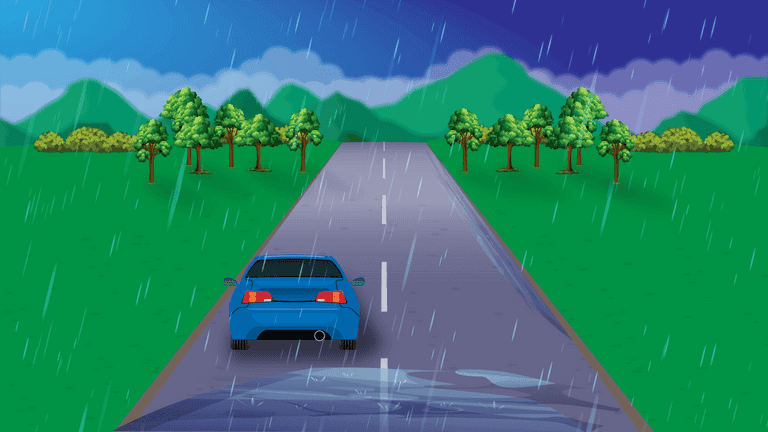
8.After a heavy downpour, why should a driver keep a greater distance from the vehicle in front?
- ABecause required stopping distances are decreased.
- BBecause wheels rotate at a greater speed after rain.
- CBecause wheels rotate at a slower speed after rain.
- DBecause wheel-spray may impair visibility.
Correct answer: D. Heavy rain can affect how well you can see and how well you can be seen by other road users. Because of that you should slow down in heavy rain and keep a greater distance from the vehicle in front.